As I’ve analyzed on Value Uncovered before with the UBET/CHDN deal, merger arbitrage (along with other special situations investments like going private transactions and tender offers) can provide solid returns during periods of market uncertainty.

Over the past several months, I’ve kept my eye on a merger opportunity between two small community banks in Pennsylvania, Tower Bankcorp (TOBC) and First Chester County Corporation (FCEC).

If structured correctly, these special situations investments can provide ‘risk-free’ profits, but investors must read the deal terms very closely or find their ‘risk-free’ position is exposed or incorrect.

Merger Background

On December 12, 2009, Tower Bankcorp, a community bank with a market cap of 134M, agreed to purchase First Chester National Bank with an all-stock transaction valued at $65M.

The stock transaction was structured using a floating exchange ratio based on FCEC’s performance until closing – at announcement, the deal was valued at $10.22 per FCEC share.

Together, the two banks would have a combined size of $2.7B in assets, with a strong presence in key markets around Philadelphia and Harrisburg, PA.

As originally planned, the merger was supposed to close in Q2 2010, subject to the necessary shareholder and regulatory approvals.

Merger Complications

During the second and third quarter of 2009, FCEC suffered from a sharp increase in the number of impaired loans, with non-performing loans jumping to 2.84% in Q3 2009.

Two days after the merger announcement, FCEC sold $52.5M in residential loans to TOBC in order to ensure the bank complied with minimum regulatory capital requirements.

Also, as part of an amendment to the merger agreement in early March, FCEC agreed to sell off its American Home Bank mortgage division, with TOBC provided a $2M line of credit as needed, once again to stay above capital requirements.

To further complicate matters, after a review by the bank’s audit committee in early March, FCEC found material weaknesses in its internal control procedures for identifying problem loans, forcing the bank to restate financials for all of 2009.

Finally, due to First Chester’s inability to file reports in a timely fashion, the NASDAQ put the stock on notice of delisting.

These complications pushed out the timeframe for closing the deal, and caused further uncertainty in the markets on whether the transaction would be finalized at all.

On the Road to Recovery

Despite the struggles at FCEC during the first quarter, the banks seemed to have made significant strides towards completing the merger:

May 24 – The banks received a first round of regulatory approvals from the FDIC and PA Department of Banking.

June 30 – Federal Reserve of Philadelphia approves the transaction, satisfying all regulatory requirements

July 27 – FCEC files restated quarterly reports for 2009, along with its annual 10-K

August 11 – FCEC catches up on its quarterly report for Q1 2010

August 18 – FCEC files a quarterly report for Q2 2010, announcing that the bank’s financials are up-to-date

Terms of the Merger Agreement

According to the merger announcement, the shareholders of First Chester would receive 0.453 shares of TOBC stock for each share of FCEC. The exchange ratio was variable, using the following table:
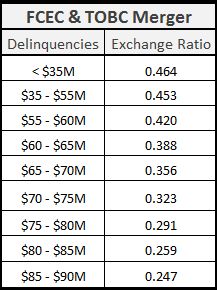
FCEC_TOBC Merger - Exchange Ratio

Delinquencies were calculated for purposes of the merger as follows:
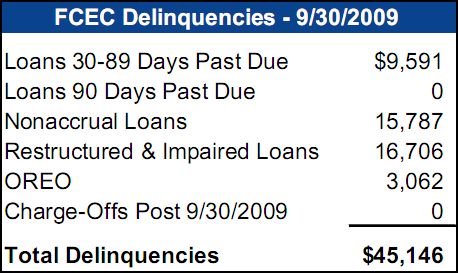
FCEC Delinquencies 09/30/2009

Inflated Exchange Ratio?

At first glance, the merger had a ridiculously high spread, leading to more investigation for a possible arbitrage opportunity.

As recently as two weeks ago, FCEC stock was trading over $8. With TOBC trading around $19, the market was implying an exchange ratio of approx. 0.420, signifying delinquencies in the $55 – $60M range.

After digging through FCEC’s latest 10-Q, as well as detail from the bank’s FDIC call reports, my calculations show a different scenario:
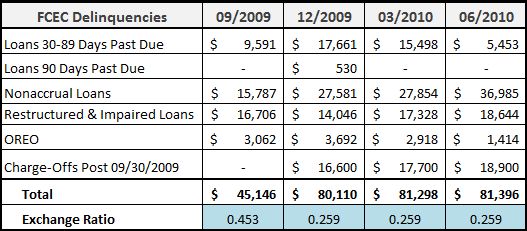
FCEC Quarterly Delinquencies Analysis

Apparently, other savvy investors have caught on, as FCEC’s stock price has fallen almost 35% in the last month, with a sharp drop occurring this past week.

However, even with the lower prices and revised exchange ratio, the stocks still appear to be mispriced:
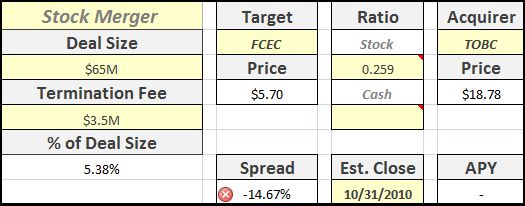
FCEC_TOBC Merger Spread Analysis

A purchase of FCEC’s shares will result in a loss of almost 15% post-merger (assuming no change in the stock price of TOBC), a significant difference.

Additional Risks

Outside of the exchange ratio issues, there remains significant hurdles to the completion of the deal.  The transaction must still be approved by the bank’s shareholders – at current pricing levels, it would seem illogical for FCEC’s shareholders to approve the deal.

FCEC also announced that the outside date of the merger would be revised to November 20, 2010, potentially pushing out the completion even further.

Conclusion

As I mentioned at the beginning of this post, merger arbitrage can offer attractive annualized returns, but there remains definite risk for investors who aren’t diligent in their analysis.

In this case, a too-good-to-be-true return scenario led to a need for further digging, and revealed a transaction that the market continues to misprice.

*Hat tip to Cale Smith over at Islamorada Investment Management for sparking the discussion. And stealing my limelight with his post! 🙂

Disclosure

No positions at the time of this writing.
Servotronics Inc. (SVT) recently reported 2010 second quarter earnings and the market reacted favorably as the company turned in another solid quarter. The stock price jumped to $10, after trading around $9 for the prior month or two.

Second Quarter Results

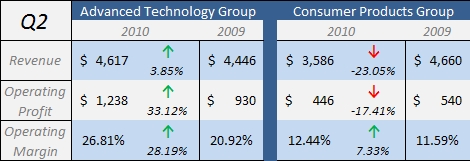
Revenues for the 2nd quarter were $8.2M compared to $9.1M in the same period last year, a drop of approx. 10%.

The Consumer Products Group was the source of the decline, with sales dropping 23%, partially offset by a slight increase in revenues for the Advanced Technology Group.

Despite the top-line drop, quarterly net income was up significantly, increasing 10% to $778k compared to $710k in the prior year quarter. For the 6 month period ending June 30, 2010, net income was 68% higher, as the company continues to benefit from an outstanding first quarter.

FCF is $1.6M so far this year, more than doubling the cash flow generated in the same period last year.

Segment Analysis

SVT - Q2 Segment Breakdown

The ATG division continues to chug along, as operating profit increased for the second consecutive quarter.

The company has also worked to improve the CPG’s product line, allowing margins to increase slightly despite the drop in sales.

Conclusion

With conservative estimates, the business is on track to generate over $3M in owner earnings for the year, close to the record set in 2008.

Management has performed well through the economic downturn – after a small hiccup at the end of 2009 – and the stock should benefit as the aerospace markets turn around (see my post on SIFCO as well).

I’m revising my conservative valuation downward slightly, to $12.50-$13.50, with an upward estimate closer to $15.

Disclosure

Long SVT

SIFCO Industries Inc (SIF) is engaged in the sale of various metalworking products and services, and has been in business since 1916.

The stock price has been volatile over the past three years, touching $24 back in 2007, falling to $4.30 in 2008, and recovering to $17 earlier this year.

The company is heavily dependent on the fortunes of the commercial airline industry (similar to SVT, a Value Uncovered holding), causing a cyclical revenue pattern – the stock price has dropped almost 40% from its yearly highs as the company struggles with weak short-term demand in the airline industry.

Despite the price volatility, the company has improved its financial condition by producing solid operating income and cash flow.

Overview

The company is organized into three different business segments.

Aerospace Component Manufacturing Group

“This segment of the Company’s business consists principally of the manufacture of forged components for aerospace applications.”

This segment is the primary driver for the company’s future growth, producing $68.6M in sales during fiscal 2009, or 73% of total revenues – a percentage that has been increasing each year. The segment also benefits from the highest operating margins of any of the business segments.

Two customers, Rolls-Royce Corporation and United Technologies Corporation account for 18% and 13% of sales respectively. Usually, this type of customer concentration poses a major risk to the business.

However, SIFCO works off of multi-year agreements and has had long-standing customer relationships going back over ten years. That is an incredibly long track record for such a small company, and shows that they provide integral services to some of the world’s largest industrial conglomerates.

Turbine Component Services and Repair Group

“This segment of the Company’s business consists principally of the repair and remanufacture of small aerospace turbine engine components.”

Over the past three years, the Repair Group has contributed between 12-14% of company sales. Although SIF owns several proprietary repair techniques and has to undergo extensive approval processes, the Repair Group segment appears to be turning into a commodity-like business.

Operating margins back up this view, averaging 0.22% over the past three years.

Applied Surface Concepts Group

“The Company’s Applied Surface Concepts Group (“ASC Group”) provides surface enhancement technologies principally related to selective electrochemical finishing and anodizing…the Company believes that the ASC Group is the world’s largest selective electrochemical finishing company”

The ASC Group benefits from a base of over 1,000 customers. Metal finishing products have much shorter lead times and smaller contract values, providing a nice balance to the long-term contracts in the ACM group.

Financials

Revenues hit a high of $101.3M in 2008 before falling to $93.8M last year. Based on fiscal 3rd quarter results, sales have dropped another 15% or so in 2010 as the company continues to deal with weak demand in the aerospace market.

Revenue decreases have also impacted the bottom line, with profits slipping 38%.

The economic downturn has taken its toll on SIF’s customers, who have delayed or reduced build rates for the company’s aircraft. Despite the short-term sales drop, the outlook remains very bright for the industry – sales should return as global demand picks up.

Despite the financial hit, the company remains solidly profitable and has continued to throw off cash. Debt to equity has dropped every year since 2004 (140.9%), and is now down to 41.5%.

Capital expenditures have increased – estimated cap-ex will end up between $5.5-5.6M, much higher than the long-term average of $2.3M – as the company expands production capabilities for its ACM group.

CROIC was a very respectable 16.5% and 18.3% over the past two years. 3-yr ROE is 17.8%, a substantial improvement over the company’s long term average.

Positive Catalysts

Industry Outlook

According to the latest report from the Aerospace Industries Association’s (AIA), the outlook for the aerospace segment is bright:

“A game changer such as the Boeing 787 airliner, as well as pent up demand for environmentally-friendly and fuel efficient aircraft will reinvigorate the aerospace industry and drive demand for years to come.”

While the pace will slow in 2011, it is an optimistic report that bodes well for the long-term success of SIFCO’s business. It also validates the company’s decision to focus on the ACM segment and should lead to higher margins in the future.

Strategic Divesture

In Jan 2009, the company announced that it was exploring strategic alternatives for the Repair Group in order to enhance shareholder value. This is a positive move, as the segment has only been mildly profitable over the past few years.

While there has been no news since the announcement, a sale to a 3rd party would allow SIFCO to concentrate on its core competency and potentially unlock value for shareholders.

Share Buyback

In June 2010, the board of directors announced a share buyback program for up to $1M. At current prices, the buyback could retire approx 2% of the company’s outstanding stock.

While not a huge amount, the buyback would boost EPS, as management believes that the current stock price does not reflect the company’s true value.

SIFCO has built up its cash position to $24.7M, so a special dividend might be a possibility as well.

Negatives

Cyclicality

Obviously, the company needs to stem the bleeding on the sales front and return to top-line growth. The business model is heavily dependent on the fortunes of the airline industry, a notoriously difficult and cyclical business.

Until revenue and profits return, the market will continue to keep the stock price depressed.

Insider Selling

Several insiders, including the corporate controller and CFO, were heavy sellers back in March and April of this year. At the time, the stock was trading at over $17, after gaining over 300% in a little over a year.

The insider trading also forewarned the drop in sales/profits in the subsequent quarter.

While I’d much prefer to see insider buying, there are certainly valid reasons for insiders to sell stocks (the timing was right around income tax season).

Trust Ownership

Currently, two trusts hold over 50% of common shares. Approx 37% is held by a Voting Trust that was entered into in 2007 as a way to

“continue the investment of the signing shareholders in SIFCO and to continue to maintain the stability of SIFCO through the Trustees’ exercise of voting control over the SIFCO Shares in the Voting Trust”

This Voting Trust looks to be at least partially setup by Mr. Smith (Director) and Mr. Gotschall (CEO) for their dependents/descendents.

The other trust seems to be for investment purposes, as most shares were purchased near the stock price lows back in 2008.

Together, they make it very difficult for a merger or acquisition to unlock shareholder value unless it is expressedly approved and in the best interest of these trusts – potentially putting them at odds with the rest of the common shareholders.

Valuation

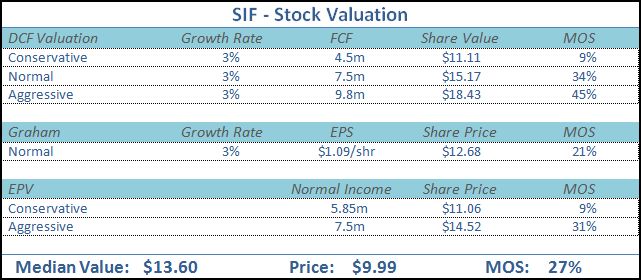
SIF - Stock ValuationThese valuation assumptions are very conservative as FCF for 2009 was 9.8M, and TTM is $7.8M.  I used a 15% discount rate for the DCF calculation.

Conclusion

The stock is a contrarian play based on the short-term numbers, as many investors will avoid a stock that has reported such poor comparables over the past two quarters.

Short-term, the company will probably suffer through another rough quarter to close out the fiscal year.

Long-term, my normal/aggressive valuation assumptions assume that sales will stabilize as the aerospace market turns around. There are several potential catalysts to help move the stock price along as well.

If the turnaround occurs, the last few quarters could be just a bit of turbulence on the flight towards future long-term gains.

Disclosure

No current positions.