
Vicon Industries, Inc. (VII) sells private network video surveillance systems – think of the video cameras in shopping malls or retail stores to catch shoplifters and detect intruders.

With a market capitalization of only $17m, the business is in a heavily competitive, cyclical industry, leading to large variability in Vicon’s revenue and income.

Revenue Fluctuations

Since video network installations generally occur in newly constructed buildings (it’s probably pretty rare that a shopping mall rips out and replaces their entire network), the company is heavily dependent on new construction and the overall economy.

Here is a chart of the company’s sales over the past 15 years:
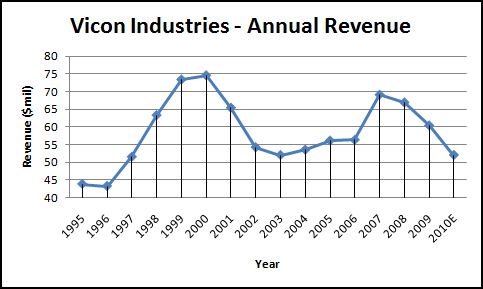
Vicon Industries Annual Revenue Breakdown

It is very clear from the chart that the company’s business is variable, with a ‘boom-and-bust’ cycle lasting approx 6-7 years. The latest upturn occurred from 2004-2007, followed by a sharp decrease in 2008-2009.

Fiscal 2010 sales will show a significant drop as well, as the most recent filing revealed that revenues are off 21%. The drop in revenue over the past three years looks very similar to the 2001-2003 time period.

Sales should level off as the economy rebounds.

Historic Financials

Vicon operates in a tough business with lots of competition from large multinational companies such as Panasonic, Sony, Bosch & GE Security.

In a tough environment, the company has done a great job improving its gross margin over the past 5 years, raising it from 38.8% in 2004 to 46.4% last year. Operating and net margins average 3% and 1.6% respectively.

Both ROE and CROIC are not the greatest, although the averages have improved to 9.8% and 8.2% respectively during the latest 3-yr upswing.

Balance Sheet Strength

It is difficult assigning a price tag on such a cyclical business, especially from an earnings & cash flow basis, so the best way to evaluate the company is through its balance sheet & assets.

The stock trades at almost half of its book value of $7.40.

VII trades at a significant discount to Net Current Asset Value (NCAV), and right around Net Net Working Capital (NNWC), a very conservative estimate of value if the company is liquidated:
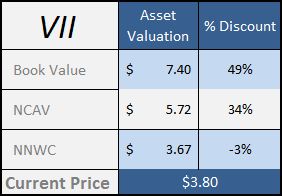
Vicon Industries (VII) Asset Valuation

These are very conservative valuations for a business that historically has traded right around book value.  However, these assume a ‘normal’ operating environment, but outside catalysts could severely affect the business as well..

Patent Litigation

One drag on the stock price is recent news regarding a piece of patent legislation originating from over 6 years ago. Back in May 2003, a company called Lectrolarm Custom Systems, Inc. filed suit against Vicon Industries regarding ‘camera dome’ pieces.

While VII does not break out sales by product category, the company reports that this product represents a significant amount of sales.

The original suit claimed damages of $11.7m, a substantial number for a company like Vicon with a market cap of only $17m.

As the suit made its (long & drawn-out) way through the USPTO system, most of the news went Vicon’s way. In a series of rulings in 2006 and 2007, the USPTO examiner declared all 5 claims invalid.

Lectrolarm re-filed the suit to the USPTO Board of Patent Appeals & Interferences (BPAI). Last week, the BPAI

“ affirmed the USPTO Examiner’s finding of invalidity of two of the claims and reversed the USPTO Examiner’s finding of invalidity of the other three asserted claims.”

This ruling reopens the patent infringement suit.

Based on the initial rulings back in 2006, Vicon seems to have a strong case to dismiss the claims, but obviously has to go through the proper channels to come to a final resolution.

It is very hard to determine a timeline for such a transaction. A negative ruling would seriously affect the stock price, while a positive verdict would remove a big weight off of the company.

In the mean time, this potential negative catalyst will put downward pressure on the stock price.

Conclusion

Based on the company’s history, business should start picking up with the global economy. As an investor, timing the very bottom of such a business cycle is extremely difficult .

However, several notable institutional investors continue to hold shares including Dimensional Fund Advisors (8.4%) and Renaissance Technologies (6.4%). According to a recent 13-G filing, another institutional investor picked up a 5% stake recently as well.

From an asset perspective, the company’s financial position remains very strong, providing the sort of downside protection that many value investors seek.

However, a prolonged recession could put the company in jeopardy and erode the margin of safety, not to mention the dark cloud of a possible patent verdict.

After experiencing three down years in a row, will VII manage to level out and start another upswing?

If so, the stock should appreciate considerably from its current lows.

Disclosure

No positions.
China Agri-Business Inc. (CHBU) has been holding in my Value Uncovered model portfolio since June, when the company was selling at a discount to its NNWC.

The company reported outstanding second quarter earnings 10 days ago, with the stock jumping over 20% on the news, before falling back over the last week.

CHBU remains in solid financial shape and is growing like crazy, and yet is trading for less than NNWC.

Financial Highlights

CHBU reported a huge increase in sales for the first half of the year on strength of the company’s “New Agriculture-Generator” initiative. Net revenues jumped an outstanding 325% to $4.99M compared to revenues of $1.17M in the prior year period.

For the second quarter, net income increased 206%, increasing quarterly earnings per share to $0.06.

Gross margin has dropped significantly compared to last year, from 73% to 35%, as the company undergoes a transformation to the new direct store sales model.

Despite the change in gross margin, both operating and net margin levels remain extremely high at 23% and 21.8% respectively (the company pays no taxes).

The company’s balance sheet is extremely solid, with a current ratio of 13.9 – with most of these assets being liquid.

Despite significant investments in equipment this year, CHBU continues to throw off cash, generating 757k in FCF for the year so far, more than doubling the amount from a year ago.

New Sales Model

Based on these results, the company is moving to an entirely new sales model going forward. Direct store sales now make up over 80% of the CHBU’s total revenues, as the traditional sales network becomes less of a focus.

Growth was largely driven by an expansion in the number of total stores, increasing from 250 to 346 in a single quarter. The company expects 500 stores by October 2010, several months earlier than previously forecasted.

Although the new model has much lower margins than the traditional network, the rapid growth like this is hard to ignore. Despite the impressive steps China has taken as a country overall, there remains a huge rural population that could benefit from the company’s products.

According to the press release,

“At the Company’s direct sales stores, farmers can purchase fertilizer products, including organic fertilizers made by China Agri, have access to the Company’s sales staff who are knowledgeable about the products offered, and receive services that include technical support. This will help farmers to increase their crop yields and productivity and, in turn, should encourage them to be loyal long-term customers for China Agri.”

Valuation

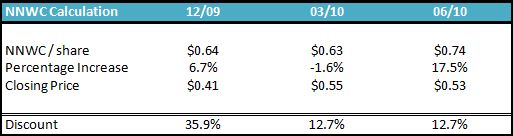
My original investment thesis was based on the fact that the stock was a Net/Net trading at less than net cash. Here are updated numbers for the past few quarters:

CHBU NNWC Calculation Q2 2010

Based on the most recent closing price, the stock is currently selling at a 22% discount to NNWC.

Conclusion

It is not often that the market provides a growing, cash flow positive stock with a market cap less than the cash on the balance sheet. CHBU is a capital-light business with little debt and obvious growth potential.

As with many Chinese stocks, management and disclosure is always a concern. The company has limited experience running a retail operation and will assuredly run into growing pains as the torrid expansion eventually slows.

The company is also in line to purchase a large parcel of land to expand capacity, a transaction that will cut into the margin of safety on a NNWC basis.

However, if CHBU continues to report operating results like this quarter, the stock might be worth holding on to as an earnings/growth play, rather than just a value investment based on assets.

Disclosure

Long CHBU

Weekend Values – August 29, 2010

Posted August 29th, 2010. Filed under Investing Links

Here are a few interesting value investment ideas from the past two weeks:

KHDHF.PK

Investment Analysis: KHD Humboldt Wedag International Ltd. (KHDHF.PK) – Purchase A Pile of Cash And Get A Competitively Entrenched, High Quality Cash Cow With Good Growth Prospects For Free

This is a thoroughly research post from AboveAverageOdds regarding a spin-off business, one of the special situations investment scenarios that has historically provided outstanding returns.

KHDFHF is an industrial business specializing in proprietary technologies for cement and mineral processing.

The company is obscure, and other factors (including only reporting financial results twice a year, located in Germany, etc) might serve to deter investors.  Despite the obscurity, the company appears to have a strong competitive position and a solid cash position to take advantage of future growth opportunities.

FURX

Furiex Pharma: Spinoff Trading at Net Cash – Continuing the spin-off theme with an analysis of Furiex Pharmaceuticals (FURX) over at OozingAlpha. FURX is a company in the drug discovery business and was recently spun-off from PPDI back in June.

Within weeks of the spin-off, the stock dropped from $18 to below $10, and has traded around there since.  Although the stock is currently trading around net cash, the business requires a high rate of cash burn while researching new drugs.

Several promising drugs in the pipeline could lead to future gains.

STRL

When All Problems Are Short-Term – Barel Karsan has a post on small-cap infrastructure company called Sterling Construction (STRL).  The company is in a very cyclical business, and appears it depends on budgets of state governments (many are struggling with tax & budget issues), resulting in margin pressure and revenue swings.

STRL doesn’t have the typical ‘value-oriented’ balance sheet, but has earnings potential for investors unconcerned with short-term results.

Net/Net List

Top Net/Net’s By Market Cap – In the spirit of Graham and other deep value investors, net/net investing has proven profitable over many years. Several recent investments here at Value Uncovered, including CHBU & ELST, were based on this methodology.

Cheap Stocks has a nice list of stocks trading at less then NCAV.  Several names on the list, such as VOXX, have been on these lists for awhile, so it is important to find those with some sort of catalyst.

Disclosure

Long CHBU & ELST