
Food Technology Inc. (VIFL) is a tiny micro-cap stock with a market cap of only 5.6M, operating in a unique industry:

“The Company owns and operates an irradiation facility located in Mulberry, Florida that uses gamma radiation to provide contract sterilization services to the medical device, food and consumer goods industries.”

Irradiation is a process of subjecting food to a short burst of high-energy radiation to break down bacteria.

Company sales are broken into three categories – medical devices (72%), food (16%), and consumer goods (12%). According to SEC filings by MDS Nordion[1. VIFL’s main source for Cobalt-60 supplies],

“Approximately 40 per cent of single use medical devices produced worldwide are sterilized using gamma sterilization technologies. Sterilization of medical devices… is a relatively mature industry with 4%-7% annual market growth.”

However, the potential market and growth opportunities for food irradiation is another story…

Debate over Food Irradiation

I think most people would agree that sterilizing medical devices is a good practice but there has been a rather intense debate about the merits of food irradiation.

Many consumers are turned away at the idea of applying radiation to food, despite the fact that academic studies have shown radiation to be a very effective way to kill bacteria and reduce the risk of foodborne illnesses.

Critics argue that irradiated food tastes differently and results in the loss of vitamins. However, most of the worry seems to be around consumer perception and general lack of knowledge regarding the procedure.

Foodborne Illnesses and Irradiation

According to the Centers for Disease Control, “foodborne diseases cause approximately 76 million illnesses, 325,000 hospitalizations, and 5,000 deaths each year in the United States.” [2. The Basics on the Foodfight over Irradiation]

Food irradiation has the potential to reduce these outbreaks and has been approved for use by many organizations including the World Health Organization (WHO), United Nations Food and Agriculture Organization, the FDA, National Aeronautics and Space Administration (NASA) and the American Medical Association (AMA).

The technique has been improved by the FDA for meat products since 1997 – Omaha Steaks, the $320m direct-to-consumer meat distributor, is a big proponent of irradiation. More recently, irradiation use has expanded to include produce such as spinach and iceberg lettuce.

Foodborne illness has been a major news topic of late, as more than 380 million eggs have been recalled due to salmonella threats.

There is no doubt that there is big potential for VIFL if food irradiation goes mainstream.

MDS Nordiron Agreement

As the radioactive materials used in the company’s work are tightly regulated, VIFL signed an agreement to procure Cobalt-60 from a company called MDS Nordiron. As payment, VIFL entered into a convertible debt agreement that allowed MDS Nordiron, at its option, to convert the debt to shares of VIFL stock.

As a result of the convertible option, MDS Nordiron owns approx. 18.2% of the company. As of Dec 2009, the company paid off the debt in full.

Financials

VIFL has been profitable for the past five years, and has shown steady growth in revenues and operating profits.

Revenues have increased from $1.7m in 2005 to $2.5M in 2009. During the same time period, operating profits have risen from $0.2M to $0.6M.

Margins are outstanding. Both gross and operating margins have been on a steady upward trend since 2006, coming in at 79.7% and 27.7% respectively last year.

The latest quarterly report shows an even greater rise, with operating margins jumping to 35.5% for the first six months of 2010.

EPS numbers have been inconsistent, primarily due to variability in income tax carryforwards.

As of Dec 31 2009, the company had unused operating loss carry forwards available of $4,931,966. These benefits can be an asset to the organization by reducing its overall tax burden. However, NOLs can cause variability in net income and EPS numbers due to the timing of the deferred tax assets

The balance sheet is rock solid. The company now has zero debt, with a quick and current ratio of 18.4 and 23.1 respectively.

Risks

MDS Nordiron has been selling off shares on a consistent basis, reducing the stake in VIFL from 23.5% in 2008 to 18.2% in 2009. MDS Nordiron sold off even more shares in June at around $2.05.

It is hard to determine MDS Nordiron’s motives regarding their ownership stake in the company but there is no doubt that consistent selling will put downward pressure on the stock price.

The other big risk for the company is customer concentration. In 2009, three customers accounted for 62% of revenue. If any of these customers were lost, it would substantially impact the business.

With that being said, the company managed to navigate the loss of a major client in 2009 who had accounted for 25% of total sales. Management was able to replace the lost business and report a slight revenue increase during the year, a major accomplishment.

Valuation
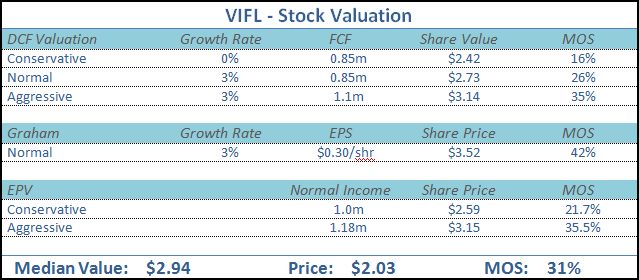
VIFL Stock Valuation

Capital expenditures were down significantly in 2009, as historically a major portion of capex expense was the purchase if Cobalt-60 supplies. VIFL has stockpiled approx. 1M curies of Cobalt 60, sufficient for the next 4-5 years at current production volumes.

Conclusion

VIFL’s fundamentals are very solid, but the stock is missing a catalyst to push the stock price substantially higher.

Continued pressure from health organizations or consumer awareness regarding the benefits of food irradiation could lead to a steady rise in revenues and profits.

Alternatively, a governmental mandate or incentives (stemming from an increased outbreak of illnesses perhaps?) might provide the nudge to food producers to aggressively switch over to irradiated foods.

Either option could increase the need for the company’s products in a big way.

I’ll be keeping a close eye on industry news, as well as watching VIFL’s stock price for an opportunity to pick up shares at a greater margin of safety.

But what do you think?  Is the stock cheap enough at current prices?

Disclosure

No position
Notes

Access Plans Inc (APNC) continues to chug along with solid results after reporting fiscal third quarter earnings this week. The stock remains substantially undervalued based on company financials despite worries about broader healthcare reform.

Sales Highlights

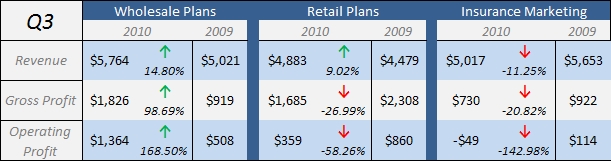
Company-wide revenue for the fiscal third quarter climbed 3% to $14.4m compared to the same quarter last year. Both the Wholesale Plans and Retail Plans divisions reported organic growth in revenue, increasing 15% and 9% respectively.

APNC Q3 Sales - Division Breakdown

At the bottom line, net income in the period increased 10% to $0.95m compared to $0.86m a year earlier.

The company’s balance sheet has steadily improved as well. Current Ratio has increased from 0.9 to 1.4 over the past year. The company paid down all of its long-term debt and FCF for the year is the highest on record.

APNC also bought back approx. 8% of shares outstanding under the stock repurchase program, bringing the total number of shares down to 19.8m.

Business Segment Analysis

The revenue increase in Wholesale Plans was especially solid as margins also improved significantly, building upon the 14.5% revenue increase in APNC’s previous quarter.

Although profits declined in the other two divisions, the company has several new initiatives underway for achieving growth targets.

The Retail Plans segment is rolling out a new offering while phasing out legacy programs. Meanwhile, Insurance Marketing is focusing its strategy on combining supplemental and life products with major medical sales:

“We believe this new approach, which was prompted by certain aspects of the Healthcare Reform Act, should maintain commission income for agents, while improving the division’s operating margins. We are in the final stages of designing this new supplemental offering, and rollout is scheduled for the first quarter of Fiscal 2011.”

Uncertainly Around Health Care Reform

In the broader market, healthcare stocks are suffering after the passing of the ‘Health Care and Education Affordability Reconciliation Act of 2010’. According to Standard & Poors, Health Care is the second worst-performing sector YTD with a loss of 6.24%.

Although many of the new rules are yet to be implemented or even agreed upon, the market has shied away from companies whose business could be affected by the new reforms.

APNC – Health Insurance Company in Appearance Only?

Looking through the financials, company revenues are almost evenly split between Wholesale Plans, Retail Plans, and Insurance Marketing.

The Wholesale Plans division contributed 40% of total sales through the first nine months of 2010 and 51% of total operating profits – it is the most important division and wouldn’t be affected by the new law.

The Retail Plans segment offers ‘insurance-like’ services outside the scope of traditional healthcare insurance regulation. While there is some risk in this area – i.e. potential customers moving to a government-sponsored health insurance program instead of APNC’s products – I think there will always remain a market for alternative offerings.

On the other hand, the Insurance Marketing segment is the one area that will immediately be affected by the new law. According to the company’s filings,

“As a result of the minimum loss ratio requirement in the Health Care Reform Law, it is likely that commissions on the sale of individual major medical insurance policies will be reduced in January 2011 and, if that happens, it could result in a significant reduction in our revenue.”

However, it is important to note that the changes will only affect the commissions ultimately paid to agents – the company’s real risk is that fewer policies will be sold under the lower commission structure:

“Most of our commission revenue is ultimately paid to our agents so the potential reduction in revenue will not necessarily cause a reduction in our profitability in the same proportion. “

Conclusion

APNC continues to report solid performance, and has solid potential for growth in each division.

Although risk certainly remains (it is often hard to predict the outcome of governmental decisions on such a testy subject as healthcare), a good portion of the business seems to be insulated by its niche focus on wholesale plans and supplementary ‘insurance-like’ products.

As the debate rages on, there doesn’t appear to be any reason why APNC should be trading so low based on the financial numbers – substantial upside to the stock remains.

Disclosure

Long APNC

As I mentioned in my 2010 year-end write-up on Techprecision Corp (TPCS), I was hoping that first quarter numbers would provide a much cleaner picture of the ‘normal’ operating results for the business.

Well, TPCS reported first quarter results for fiscal 2011 last week and the market approved, as the stock jumped 20%.

Financial Highlights

Net revenues were up 85.4% to $6.2m compared to the first quarter revenues last year.

Most of this rise was attributed to the resumption of orders from the company’s largest customer, GT Solar. GT Solar’s orders totaled $3.7m, compared to zero in the corresponding quarter last year.

Gross margins were 37.6%, much higher than the 17% gross margin in the same period last year. Margins were artificially depressed last year due to a large shipment of raw inventory in August 2009.

Until the inventory is worked off, TPCS will benefit from higher margin, service-based sales. With a more evenly mixed batch of services and product sales, the company’s gross margin should end up in the high 20’s on a percentage basis.

For the quarter, the company turned in a profit of $819k, a substantial improvement on the quarterly loss last year.

Revenue & Backlog Composition

While it is good to see the resumption in sales to GT Solar, an important part of my investment thesis is that the company is able to diversify its business.

Total backlog increased from $21.5m last quarter to $25.2m for the quarter ending June 30, 2010. This is a key indicator of TPCS’s prospects going forward.

Looking closely at the revenue numbers, the company’s other business segments outside of solar energy lagged, coming in approx. $900k lower than the same period last year. These are large complicated contracts, so some variability in quarterly results is expected.

Based on future outlook however, the company’s prospects seem to be bright – Non GT Solar backlog in the quarter was $17.3m compared to $11m at the same time last year.

Future Growth

According to the company:

“We believe that rising energy demands along with increasing environmental concerns are likely to continue to drive demand in the alternative energy industry, particularly the solar, wind and nuclear power industries. Because of our capabilities and the nature of the equipment required by companies in the alternative energy industries, we intend to focus our services in this sector. ”

As an example of this potential, on August 6, TPCS announced a multi-million dollar letter of intent from an emerging clean tech firm.

This order should translate into several thousand dollars of project engineering revenue in the next few months, initial production units within the next year, and a heavy increase in sales revenue in 2011 and 2012.

New CEO

After a lengthy search, the company announced the hiring of James Molinaro as the new CEO on July 22.  Mr. Molinaro has a diverse background, with over 26 years of experience in solar and semiconductor equipment production.

According to the press release, at his previous company Mr. Molinaro

“was responsible for diversifying the Company’s revenue streams and expanding business opportunities by tapping into the lucrative solar energy, military application and ink jet printer markets, increasing annual sales by approximately $32 million to $83 million over a four-year period. “

Hopefully he can guide TPCS on a similar path.

Although this was a necessary step for the company, hiring such a senior executive can also function to dilute existing shareholders due to stock incentives. Mr. Molinari’s offer letter allows for option grants for up to 1M shares of company stock, a substantial number.

Conclusion

Looking back, TPCS was trading north of $3 a share in 2007/2008 before GT Solar’s business took a nose dive, so the market has certainly priced in growth potential for the stock before.

As TPCS’s largest customer, GT Solar seems to be having a good year, as the stock is up over 50% YTD after reporting an order backlog of over $1B – hopefully this backlog will lead to increased sales for TPCS.

The dark days of 2009 seem to be behind the company.  While still cheap based on current financials, the stock should jump considerably if GT Solar’s business continues to rebound or if one of the other business segments takes off.

It remains to be seen whether the new CEO can use his expertise to further diversify and grow the business.

Disclosure

Long TPCS