
In addition to merger arbitrage and going private transactions, another type of special situation is tender offers. A self-tender offer is a form of share repurchase where a company offers to purchase a portion of its outstanding shares from those shareholders who vote to ‘tender,’ or turn in, their shares in exchange for cash.

This is another area where small investors have an advantage over the bigger guys. Many self-tender offers include an ‘odd-lot’ provision for shareholders holding less than 100 shares. It basically guarantees that the company will repurchase these odd-lots before the rest of the offer is fully subscribed.

One example of this sort of investment opportunity is Validus Holdings (VR).

Announcement

On May 6, VR announced a Modified Dutch Auction Tender Offer for $300m of common shares. The price range for the auction was set for $24-$27.50 per share. The offer will be paid for with cash on hand (so no financing risk) and includes the important ‘odd-lot’ provision.

Entry Point

Since the tender offer announcement, the stock traded below $24 several times over the past month. A strategic entry point at or below the minimum range of the tender offer, combined with taking full advantage of the odd lot provision, will likely recent in a profitable trade, with potential for decent upside.

Return Scenarios
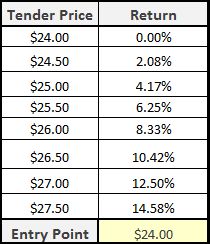
VR Tender Offer Return Scenarios

Final Tender Price

TBD. The tender offer expired yesterday so hopefully results will be announced in a few days.

Results – *Updated*

On June 9, 2010, the Company announced the results of the dutch auction tender offer:

Validus Holdings Announces Preliminary Results of Dutch Auction Tender Offer

“Based on these preliminary results, Validus expects to purchase 12,000,000 common shares, subject to proration, at a price of $25.00 per common share for a total cost of $300.0 million”

Obviously, this is at the lower end of the given range.  Still, if you picked up shares two weeks ago for $24, the transaction still resulted in an annualized return of 110%!

Disclosure

Long VR
Lately, my normal screening tactics have returned very few investment opportunities that satisfy my traditional ‘bargain bin’ value investment philosophy. Because of this, I’ve been doing more and more research on arbitrage opportunities and other special situations to round out my portfolio.

(See analysis example of the PBCI & BCBP merger)

I’m happy to report that I officially completed my first special situations investment last week, when CHDN merged with UBET. For more background, check out my initial writeup on the merger.

Announcement

Filed on Wednesday June 2:

“Churchill Downs Incorporated (“CDI”) (NASDAQ: CHDN) announced today that it has completed its merger with Youbet.com, Inc. (NASDAQ:UBET). As a result of the merger, each share of Youbet.com common stock was converted into the right to receive 0.0591 shares of CDI stock and $0.99 in cash.

The initial terms of the deal called for a conversion ratio of 0.0598 in CHDN stock and $0.97 in cash.  However, the conversion ratio was open to adjustments in order to limit the number of shares CHDN was required to issue.

Investment Breakdown

Based on my initial entry points, the arbitrage opportunity was offering estimated gains of approx. 12.5%.  I’ve included my timeline below.

  1. May 5 – I entered an initial position in UBET at $2.90. At the same time, I entered a corresponding short position in CHDN at $38.29, based on the conversion ratio of 0.0598.
  2. May 7 – I added to my position in UBET at $2.80, balanced with a short position in CHDN at $36.51.
  3. June 2 – Official merger announcement
  4. June 5 – My UBET shares were converted into shares of CHDN at the new conversion ratio and I received cash considerations of $0.99 per share.  Due to the slight difference in the conversion ratio on closing, I ended up with a few extra shares of CHDN which I quickly covered at $32.35.  I then closed out long/short position in CHDN to end the trade.

Return

To wrap my head around the accounting, I considered the two trades as separate positions. Overall, I gained 12.25% and 12.45% respectively, or 308.15% and 317.02% annualized.

Takeways

-This was my first time shorting stock and I was never aware that brokers charge “hard-to-borrow” fees on all but the most liquid stocks. Since most of my investments will be in obscure opportunities, this is definitely something to keep in mind.

BTW, does anyone have brokerage recommendations? I’m using currently Zecco  (the free trades are great) but might need to expand if I continue with these more complicated transactions.

-Merger arbitrage, especially stock & cash mergers, involve much more complicated gain/loss scenarios than standard stock investments. I spent way too much time figuring out my final tally on this position.  In hindsight, it might have been prudent to start with a simpler transaction but I’m happy I forged ahead – the return was too good to pass up!

-As in all investment scenarios, it is important to have a margin of safety in any transaction. Too many things can go wrong with merger arbitrage  – entry points, commissions, market timing, fractional shares, etc. all make the real world outcomes of these types of trades different than how they appear on paper.

-Successful special situations investments have the potential for truly eye-popping annualized gains.

Access Plans, Inc (see initial writeup on APNC) reported solid second quarter results but the stock has been on a steady downtrend since the announcement.  With no news, this is the type of market volatility that investors must ignore and is a great time to pick up additional shares.

Overview

Overall, second quarter revenue increased by 128%, due primarily to the company’s acquisition of Access Plans USA in April 2009.  This acquisition significantly expanded the scope of APNC’s Retail Plans division and created an entirely new business segment – Insurance Marketing.

Division Breakdown

With three distinct segments, it is important to take a look at each individually:

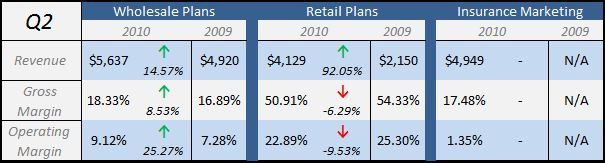
APNC Q2 Division Breakdown

The highlight of the earnings report was that the Wholesale Plans division contributed 15% organic growth and improved margins significantly across the board.  Representing 42% of the Company’s revenue, this division is the most mature of the business units.

On the Retail Plans side, the acquisition allowed the Company to almost double top-line revenue, but caused a slight hit to margins.  It will be important to keep an eye on these margin numbers to see if management can further streamline operations to return to pre-acquisition profitability.

The Insurance Marketing division runs a very tight ship, with average operating margins around 3% (1.35% for the 2nd quarter).  This division has no comparables available for 2009.  With the passage of the health care reform bill, the Company plans to transition their product mix towards association-based insurance products:

“…we are focusing our efforts on transitioning the Division’s mix from major medical insurance to emphasize more profitable supplemental insurance products.”

If there is a common theme among the business segments, it’s ‘associated-based’ products, so the Company should be comfortable making the transition.  If it occurs, the company should benefit from the higher margin offerings.

Other Financial Information

The Company has generated $2.12M in Owner’s Earnings during the first two quarters of the year, a 20% improvement over prior year numbers.  After paying off the final portion their $1M note payable, the Company has no long-term debt.   Tangible stockholder equity is positive and has steadily increased after several years with a negative balance.

Valuation

Based on the Company’s current stock price, the market is not pricing in any growth opportunity from the recent acquisition. With the most conservative estimates (0% growth, current owner’s earnings levels), APNC should be worth north of $1.70 per share.

Under modest growth assumptions, I calculate an intrinsic value between $2 and $2.50 per share.

Next quarter’s numbers will be the first to show relevant year-to-year comparisons on how APNC is shaping up as a combined entity.  I will be watching these numbers closely.

Disclosure

Long APNC

*Hat tip to OSV for the chart formatting.