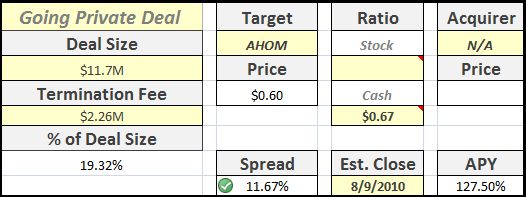
American Homepatient, Inc. (AHOM), announced on April 28th that it will be bought out and taken private by its largest shareholder, Highland Capital Management.  This is another example of a special situations investment (see my writeups on the CHDN/UBET merger and VR tender offer as well)

History

The Company has been in financial straits since August 2009, when it effectively breached the covenants for repaying its senior debt.  Since that time, the Company has been acting under short-term forbearance agreements with its lenders.

If the going private transaction is approved, the lenders have agreed to a substantial restructuring of the existing debt, allowing the Company to avoid bankruptcy.

According to this article, Highland Capital offered to buy the company in 2006 for $3.40 per share but was unsuccessful. Now, with the Company’s continued struggles, it doesn’t look like shareholders have much choice but to approve the offer.

Why the Attractive Spread?

Even though this looks like the only option if shareholders want to avoid being wiped out in bankruptcy, the merger still offers attractive an arbitrage opportunity. Why?

The transaction seems more complicated on the surface than a typical going private transaction. I’ve broken down the steps below:

Steps for Merger Completion

1. “This repurchase would not be possible if the Company remained incorporated in Delaware. A Delaware corporation is prohibited from repurchasing its own shares if after giving effect to such purchase its net assets would be less than its capital. Nevada law differs and would permit such a repurchase. Reincorporation in Nevada is, therefore, a necessary step in carrying out the repurchase as contemplated by the Restructuring Support Agreement.”

Under the terms of the merger agreement and restructuring, AHOM cannot legally repurchase its shares as a Delaware corporation. The vote on reincorporation will occur at the company’s annual meeting of shareholders on June 30, 2010.

2. “Conditioned upon approval of the reincorporation by our stockholders, we agreed to carry out the reincorporation.”

Highland owns 48% of outstanding shares and has voted to approve the transaction. With this in mind, the reincorporation is almost guaranteed.

3. “If the reincorporation is approved and carried out as described above, we agreed that AHP Nevada will then commence a self-tender offer to you at $0.67 per share.”

The tender offer will expire after 20 business days.

4. “In the event the self-tender offer is accepted by a number of our stockholders other than Highland and its affiliates holding shares that together with the shares owned by Highland and its affiliates represent at least 90% of the number of its outstanding shares, and subject to other customary closing conditions, AHP Nevada agreed that it would repurchase all of the tendered shares.”

The voting numbers from the shareholder meeting should be watched closely, but I’m assuming this will pass as well.

5. “If the self-tender offer is completed, Highland has agreed to initiate a follow-on merger at the conclusion of the self-tender offer pursuant to which shares of common stock in AHP Nevada not tendered and not held by Highland and its affiliates would be cancelled in exchange for $0.67 per share.”

Any additional shares not tendered will be cashed out at $0.67 per share.

Timeline

The annual meeting of shareholders will occur on June 30, 2010. If shareholders vote to approve the reincorporation, the tender offer will be initiated within 5 business days, and remain open for 20 business days.

Assuming the votes are approved, I’m estimating the transaction should close the second week of August – consistent with the terms of the merger agreement: “if the Merger Closing shall not have occurred on or before August 10, 2010 (the “ Merger Deadline)

Return

AHOM Going Private AnalysisThe stock has been trading under $0.60 over the past month, and as low as $0.56.

Final Thoughts

If the transaction is not completed, substantial risk remains, as the stock was trading under $0.20 before the merger announcement.

Although I’m sure some of AHOM’s long-time shareholders are disappointed by this result (especially when compared to the offer from 4 years ago), I think it is the only option for the Company. Several executives have been exercising stock options in the past month, a sign they expect the transaction to go through.

Update – 7-07-10

AHOM announced the launch of the tender offer today.  The transaction seems to be on schedule, with the expiration of the tender offer on August 4.

The main condition that still needs to be satisfied is that >90% of outstanding shares actually tender their shares.  Since 96% of shares voted to approve the merger, I think it’s likely that a similar number will tender their shares during the offer period.

AHOM SEC Filing

Documents

[table id=4 /]

*Update – 8/05/10

Step 4 of the going private transaction – the self tender offer – was supposed to wrap up yesterday.  Greater than 90% of shares needed to be tendered in order to complete the transaction.

Yesterday, AHOM announced an initial count, with 6,848,732 or 87% of shares validly tendered.  Therefore, the company is extending the offer until August 25.

Although it is disappointing that the transaction won’t wrap up this week (from a time value of money standpoint), it seems pretty likely that the company will get the last 3% it needs.

Disclosure

Long AHOM
Company Description

China Agri-Business Inc. (CHBU) sells “Green Food” certified fertilizer, primarily in the rural areas of China:

“China Agri-Business, Inc., through its operating company in China, manufactures and sells non-toxic fertilizer, bactericide and fungicide products used for farming in the People’s Republic of China (the “PRC”). Crops grown with our products are eligible to qualify for the “AA Green Food” rating administered by the China Green Food Development Center, an agency under the jurisdiction of the Ministry of Agriculture of the PRC.”

Fundamental Numbers

Since inception in 2006, the Company has maintained impressive margins across the board. Median gross margins of approx. 70%, operating margins of 40%, and net margins of 38.8% are very solid.

Tangible stockholder equity has increased from 4.5m in 2006 to 10.3m in 2009. Median ROE and CROIC of 16.5% and 13.7% are decent as well.

Growth Plans

Although the Company has outstanding margins, top line sales have stalled around $3m for the past three years. Management is trying to counter the slowdown in their traditional sales network by rolling out a new growth initiative, the “Super Chain Sales Partner Program”. The initiative has two parts underway:

Super Chain Stores

The “Super Chain Sales Partner Program” is an initiative whereby the Company agrees to provide a $3,000 advance payment to participating retailers in exchange for their commitment to purchase and sell approximately $14,000 worth of the Company’s products per year. Each participating retailer must also agree not to sell any competing products. ”

Total Chain Stores: 100

Direct Stores

“The direct sales stores are controlled and managed directly by the Company.”

Total Direct Stores: 250

The Company is opening new stores at a very rapid pace, and expects almost 500 Direct Stores by the end of the year.

Since these direct stores also sell 3rd party manufactured products, they have much lower gross margins than the other sales channels. For the most recent quarter, margins for the direct stores came in at 32%, much lower than the 70% historical gross margin average for the traditional business.

However, the initiatives are certainly adding to revenue and net income, as both tripled from the same period last year.

Liquidation Value

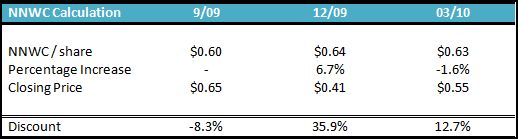
I was originally drawn to CHBU as a net-net investment. It is very rare to find profitable, growing company that is trading for less than NNWC, especially less than Net Cash.

CHBU Net-Net Calculation

However, a line item buried in the 10-K caught my eye:

Land Purchase

“On October 21, 2009, Xinsheng received an approval letter from the Bureau of Foreign Trade and Economic Cooperation of Lantian County of Xinsheng’s application to purchase land use rights in Lantian County to establish “Xinsheng Centennial Industrial Zone”. Xinsheng intends to purchase the land use rights for 66 acres for a term of 30 years. The land use right purchase cost is expected to be approximately $4.1 million (28,000,000 RMB).”

The purchase has been delayed by the local government but is a huge cash outlay for the Company, over 40% of the current cash balance. I emailed Investor Relations about this transaction, and the CFO replied that they plan on increasing capacity and expanding their sales networks on this land – hopefully, I get some further clarification.

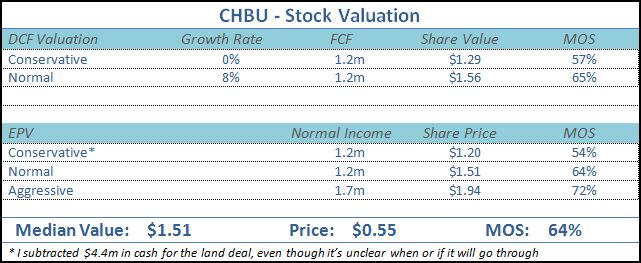
This purchase will remove the margin of safety from a liquidation perspective, so it’s necessary to evaluate the business as a going concern:

Stock Valuation

CHBU Valuation

As with all micro-cap stocks, entry point is crucial.  Despite the recent surge, the stock was trading at $0.50 last week.

Risks

-The land purchase seems like a very risky move for a company that does not have access to a bank line of credit. A downturn in demand or backfire of the expansion plans could place a major strain on the Company’s cash position.

-The Company could over-extend with these expansion plans, especially considering they have little prior experience in the retail business. Over-emphasis on the direct stores method will hurt gross margins, one of the most attractive statistics in the traditional business.

-As a commodity company, CHBU is at the mercy of weather patterns and other economic disasters such as earthquakes. These are the sort of one-time events that are outside of investor control and could change the economics of the business in a hurry.

Conclusion

Although I entered the investment as a net-net play, I’m comfortable with the growth potential that the stock offers. If management can deliver on the expansion plans, results for 2011 could be very impressive. I’ll be watching Q2 numbers closely.

Disclosure

Long CHBU

Overview

New Frontier Media (NOOF) reported 4Q and 2010 fiscal year results last week. The Company continues to struggle with a decline in domestic revenue and the impairment of intangible assets. There is no doubt that the economic downturn is negatively affecting the company, but the Company remains in solid financial shape, especially from a cash flow and balance sheet perspective.

Sales Results

Net sales decreased to $50.4m, a 4.4% drop from the prior fiscal year. In the Transactional TV segment, sales decreased by 12%, partially offset by a 40% increase in the Film Production segment. Profit margins in the TV segment average around 70%, compared to margins around 50% for the other business segments – if the trend continues, the Company will need to closely monitor costs, or bottom line profitability could erode further.

However, several bright spots remain from a top-line analysis:

The 4.4% sales decreased was moderate compared to the 11.7% drop in revenue from 2008 to 2009, the (hopeful) start of a positive trend. Q4 revenues of $15.1m were the highest quarterly revenue since Dec 2007. Although domestic business has stagnated, international sales increased 61.7% and now makeup 14% of total sales.

Owner Earnings

In the past two years, the Company has been forced to write down a significant portion of their intangible assets (writedowns of $11.31m in 2009 and $7.19m in 2010). Overall, goodwill and other intangible assets have dropped from approx $22m in 2008 to approx $4.3m in 2010.

As an investor, this shows the danger of investing in companies with a substantial balance of intangible assets – the value of those assets can be fleeting when compared to hard assets like cash or PP&E.

The good news is that the Company has written off all of the goodwill from the Film Production business, so further writedowns are unlikely.

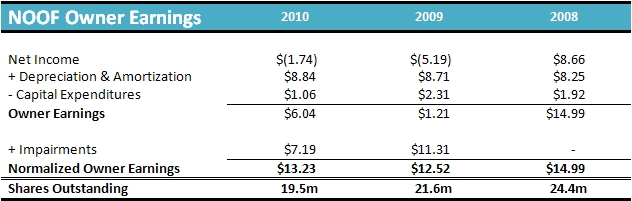
Despite the non-cash charges, NOOF continues to generate healthy Owner Earnings (OE), with $6.04m in 2010:

NOOF Owner Earnings Analysis

Add back the non-cash impairment charges, and a clear uptrend in ‘normal’ owner earnings over the past two years can be identified, despite the net losses.   In most cases, cash flow is usually a better indicator of the financial health of the business.

Balance Sheet

Although the company’s topline performance will probably continue to struggle, the balance sheet is solid – especially since the majority of the intangible assets have been eliminated.

The Company’s quick and current ratio is 3.2 and 3.5 respectively, the highest numbers since 2005. Total liabilities dropped almost $5m, as the Company reduced accounts payable by 29% and paid off $3m off their outstanding credit line.

Valuation

Even with no growth, the company looks extraordinary cheap. At current levels, NOOF is trading at 5.5x OE. With conservative topline estimates going forward (and no writedowns), the business should generate roughly $12m in owner earnings in 2011, or 2.6x OE at current price levels.

Conservative Valuation: $2.5-$3.5

Aggressive Valuation: $5-6

Disclosure

Long NOOF