Analysis

PBCI & BCBP Merger Analysis

Background

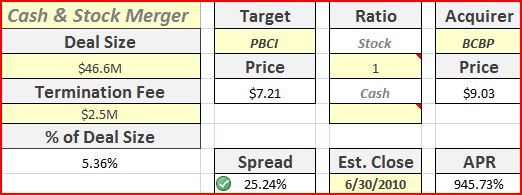
On June 30th, 2009, BCB Bancorp Inc (BCBP), a small community bank with three branches in NJ, offered to purchase Pamrapo Bancorp (PBCI) in a transaction valued at $46.6m. It was a friendly transaction with both company’s board of directors voting for the merger.
Mark Hogan, Chairman of BCBP –

“We believe the partnership will solidify the combined entity’s Hudson County franchise and presents the opportunity to generate earnings and attractive returns to both groups of shareholders. The combination will greatly assist us in developing a more responsive and efficient institution while holding true to our tenet of customer service.”

Kenneth Walter, CEO of PBCI –

“We believe that this transaction is a great opportunity for our shareholders and will benefit our customers, employees and our community. We can continue with our philosophy of providing a high level of customer service and local decision making in our market area but will now have the added benefits of being part of a larger organization with much greater resources, lending limits and convenience for our customers.”

Terms

PBCI shareholders will receive 1.0 share of BCBP.

Shareholder Complaints

Despite friendly management terms, it has been a rough road since the merger announcement. On Dec 2, 2009, PBCI’s former president and largest shareholder, William J. Campbell, filed a complaint that the bank did not fully disclose the cross-ownership between the two entities by members of the board of directors. This joined another shareholder complaint filed by Keith Kube, who argued that the board of PBCI breached its fiduciary duties to shareholders.

Shareholder complaints seem to be common occurrences in many corporate mergers, but they rarely end up changing the outcome. On Feburary 17, 2010, the court of NJ voted to dissolve its injunction that was blocking the merger, opening the door for the shareholder vote.

Shareholder Approval

BCBP Shareholders voted to approve the merger on Dec 17, 2009. PBCI’s shareholders followed suit and voted to approve the merger on February 17, 2010, with 77% of shareholders voting to approve the transaction.

Investigations

To complicate matters even further, it seems that PBCI has been under investigation for quite some time for various issues. The bank received a Cease and Desist Order from the Office of Thrift Supervision back in September of 2008, and received another on Jan 22, 2010 relating to unresolved deficiencies in management and succession plans. The bank had to submit a 3yr business plan and hire 3 outside independent directors to satisfy OTS’s requirements

To make matters worse, the DOJ had been investigating the bank for several years for lax controls around anti-money laundering laws. On March 29, 2010, the bank pled guilty to the DoJ’s charges and was ordered to pay a $5m civil penalty.

Despite the setbacks, PBCI’s 10-Q on May 17, 2010, reports that the merger has received all necessary regulatory approval.

Discussion

It doesn’t appear like anything is stopping the merger from completing in the near future. Although all of the investigations look terrible for PBCI, BCBP has not given any indication that it will back away from the merger. I’ve read through most of the press releases, and it seems like PBCI’s management a) is incompetent or b) disregarded numerous compliance and regulatory rules that come with owning a financial institution.

Another concern with this arbitrage opportunity is the illiquidity of both stocks. PBCI trades roughly 3000 shares a day, while BCBP trades only 1000. It would be difficult to short BCBP, and the large bid/ask spread could eat into profits when exiting the trade after the completion of the merger.

It seems like many investors have been caught up in the bad press surrounding the merger, while the companies have slowly crept closer to completion by satisfying all of the necessary requirements one-by-one.  The spread is very attractive, but only if investors can successfully pull off the trade.  Thoughts on this opportunity?

Supporting Documents:

[table id=1 /]

Disclosure

No position in either PBCI or BCBP at the time of this writing.
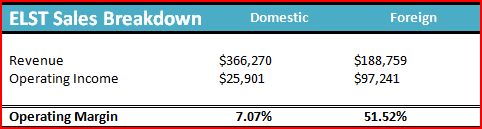
ELST filed its Q1 results on March 13th and reported a solid, if unspectacular, quarter. Total sales increased by 23% compared to the first quarter of 2009. Domestic sales were basically flat but foreign sales jumped almost 82%, due to higher demand for the company’s products from industrial automation projects in Chile, India, Colombia, and Peru. Operating margins are significantly higher on foreign sales – see chart below:

ELST Q1 Sales Breakdown

Foreign sales accounted for 34% of total sales in 2009, compared to 23% in the previous year. Hopefully management will continue to focus company sales efforts on this segment going forward.

Despite the improved results, management is still very cautious for the rest of 2010 –

“Management believes that the tenuous worldwide economic recovery makes sales revenues during 2010 difficult to predict and prone to potential fluctuation”

As a going concern, I think the business could be worth anywhere from $.75-$1 per share, substantially higher than the latest closing price. Barring a potential catalyst, it is very important to understand the downside risk as well:

ELST NNWC Calculation

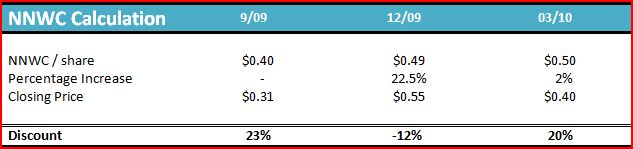
Based on the company’s latest closing price of $0.45, the stock is trading for 10% less than the sum of its assets its liquidation value, providing a nice cushion to the downside.

Also, Paul Sonkin of Hummingbird Capital has increased his stake from to 16% to 21.1% of the company. Hummingbird Capital is a very successful hedge fund manager that focuses on nano-cap plays selling at a discount to their intrinsic value. Paul recently spoke at the Value Investing Congress (see a great writeup here: 2010 Value Investing Congress Notes by The Innoculated Investor)

It is always nice to have an expert on your side!

Disclosure

Long ELST

Take a look at Span-America Medical System’s price chart for the past month. The chart shows a huge fluctuation from $16 up to almost $20 before dropping back almost as rapidly. First quarter results were released on May 3rd. Why such volatility?

Dividend

The company announced a special dividend of $1.00 to stockholders of record on May 20. In addition to the company’s normal $0.10 quarterly dividend, SPAN paid out a total of $1.10, a tidy 6% return based on an average closing price before the announcement.

This is the 82nd consecutive quarter that SPAN has paid a cash dividend, just over 20 years, and pretty astounding for company with a market cap of $42m. Total payments over that time represent $8.67 per share, over 50% of its current price. Paying such a dividend shows a solid commitment to returning value to shareholders, and is definitely a good sign for the financial health of the business.

Quarterly Analysis

In addition to the dividend news, the company also turned in a pretty solid earnings report despite decreasing sales across the division. Net income for the quarter increased 18% to $1.2m or $0.44 per share, primarily driven by strong cost controls. Both Inventory and Total Liabilities dropped as well, making the balance sheet look even better.

Owner’s Earnings

Based on my calculations, the company has generated approx. $2.6m in owner’s earnings YTD, a 37% increase from the same point last year – not to mention a 13% increase compared to the company’s best year ever for owner’s earnings. As this is a major portion of my valuation analysis, I feel comfortable that SPAN should be valued at the high end of my original estimate.

Other Highlights

“This was our second sequential quarterly increase in industrial sales,” stated Mr. Ferguson. “Second quarter sales rose almost 31% compared with the first quarter of fiscal 2010. Although this business represents a small part of our total sales, it has been a good leading indicator of sales trends due to our broad customer base for industrial products.”

Although sales were down roughly 5% YTD, this is a small sign of encouragement from the CEO. Hopefully these trends will carry over into the other business segments.

“Our outlook for the custom products segment is also positive. In the consumer business, we have finalized plans to supply a line of bedding products to a new, large retail customer beginning around June 2010.”

Although there is no way to tell how large this new retail customer will be, could this be a potential catalyst for improved sales results to finish out the year? The custom products section makes up 28% of total sales, so a significant increase here would have an impact on the bottom line.

Conclusion

Management continues to reward shareholders and showed good judgment during the course of the economic downturn. Even with the most conservative assumptions, I think SPAN is worth north of $20. Based on this report, I’m revising my price target slightly upward, to $27-$30, a significant discount to its current market price.

Read about my original investment thesis for SPAN

Disclosure

Long SPAN