
Access Plans, Inc (see initial writeup on APNC) reported solid second quarter results but the stock has been on a steady downtrend since the announcement.  With no news, this is the type of market volatility that investors must ignore and is a great time to pick up additional shares.

Overview

Overall, second quarter revenue increased by 128%, due primarily to the company’s acquisition of Access Plans USA in April 2009.  This acquisition significantly expanded the scope of APNC’s Retail Plans division and created an entirely new business segment – Insurance Marketing.

Division Breakdown

With three distinct segments, it is important to take a look at each individually:
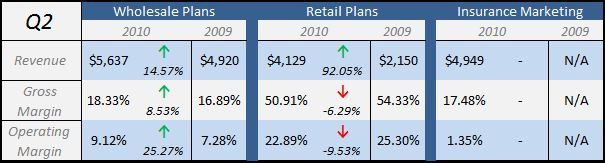
APNC Q2 Division Breakdown

The highlight of the earnings report was that the Wholesale Plans division contributed 15% organic growth and improved margins significantly across the board.  Representing 42% of the Company’s revenue, this division is the most mature of the business units.

On the Retail Plans side, the acquisition allowed the Company to almost double top-line revenue, but caused a slight hit to margins.  It will be important to keep an eye on these margin numbers to see if management can further streamline operations to return to pre-acquisition profitability.

The Insurance Marketing division runs a very tight ship, with average operating margins around 3% (1.35% for the 2nd quarter).  This division has no comparables available for 2009.  With the passage of the health care reform bill, the Company plans to transition their product mix towards association-based insurance products:

“…we are focusing our efforts on transitioning the Division’s mix from major medical insurance to emphasize more profitable supplemental insurance products.”

If there is a common theme among the business segments, it’s ‘associated-based’ products, so the Company should be comfortable making the transition.  If it occurs, the company should benefit from the higher margin offerings.

Other Financial Information

The Company has generated $2.12M in Owner’s Earnings during the first two quarters of the year, a 20% improvement over prior year numbers.  After paying off the final portion their $1M note payable, the Company has no long-term debt.   Tangible stockholder equity is positive and has steadily increased after several years with a negative balance.

Valuation

Based on the Company’s current stock price, the market is not pricing in any growth opportunity from the recent acquisition. With the most conservative estimates (0% growth, current owner’s earnings levels), APNC should be worth north of $1.70 per share.

Under modest growth assumptions, I calculate an intrinsic value between $2 and $2.50 per share.

Next quarter’s numbers will be the first to show relevant year-to-year comparisons on how APNC is shaping up as a combined entity.  I will be watching these numbers closely.

Disclosure

Long APNC

*Hat tip to OSV for the chart formatting.
Analysis

EMMS Going Private Analysis

Background

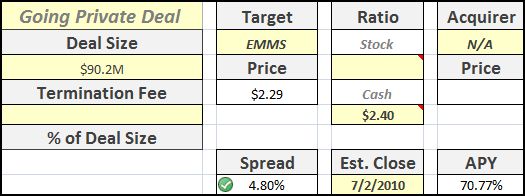
On May 25, 2010, Emmis Communications Corporation announced that it signed a merger agreement with JS Acquisition, LLC, a company owned by EMMS’s Chairman and CEO, Jeffrey Smulyan, effectively taking the company private. Common stock holders will be cashed out at $2.40 per share in a deal worth approx. $90.2m. The deal has been in the works since late April, when the company received a letter of intent regarding the going private transaction.

Terms

Holders of Class A common stock will receive $2.40 for each share tendered. Other considerations are due to preferred stock holders.

Shareholder Complaint

As often happens in these transactions, several lawfirms are investing whether the board of directors breached its fiduciary duties to shareholders by accepting the going private offer. These lawsuits allege that the closing price of $2.40 is only 11% above the most recent closing price of $2.38.

However, I do not see this as being a major roadblock to the transaction. The only reason for the small premium was that a letter of intent was signed back in April. The $2.40 offer is 74% above the 30-day average trading price and 118% above the 180-day average trading price, a significant premium.

Board Approval

The board approved the transaction in conjunction with the merger announcement.

Shareholder Approval

In order to approve the transaction, a majority of common shareholders must tender their shares in favor of the merger. Since Jeffrey Smulyan owns 60% of outstanding Common Shares, this part of the approval is already assured.

In addition to the common shareholder approval, 2/3 of Preferred Stock holders must also vote to tender their shares. Alden Global Capital, the asset management company that is providing financing for the transaction, holds 41% of outstanding preferred shares and has voted to approve the merger.

This means only 25% of preferred stock holders must vote to approve the merger in order for the transaction to go through.

Timeline

The tender offer will commence on June 3, 2010 and will last at least 20 business days. Assuming preferred shareholders promptly tender their shares, the going private transaction should commence sometime around July 1, 2010.

Discussion

Unless something falls through with the financing, I don’t see very many risks with this transaction. Jeff Smulyan controls the majority of the company and seems to have the backing of the board and the largest preferred shareholder. I’m anticipating the merger will go through in July.

Shares can be picked up for $2.29 per share, resulting in a quick ~5% return in just over 30 days

Supporting Documents

[table id=3 /]

Disclosure

Long EMMS

Servotronics reported Q1 results two weeks ago, and the market certainly reacted favorably! Almost 44k shares traded hands – average volume is around 2k – and the stock jumped almost 30% during intraday trading before closing at $10.04, a 19.54% gain. The stock has dipped since then but it’s rising back towards $10.

Back in March, investors will remember that the stock took a 25% hit after reporting a large decrease in net income, as the Consumer Product division barely broke even for the year.  I certainly felt like the March drop was an overreaction and the company’s press release seemed to back up this sentiment:

Notwithstanding the reported reduction in year to year net income, the net income for 2009 was the 3rd highest net income reported by Servotronics during the past 25 years. Also, the 2009 reported net income was approximately 50% higher than the reported net income for the Company’s 4th best year during the same 25 year period. The Company’s 3 best years, as measured by net income during the past 25 years, occurred during the last 3 years (i.e., 2009, 2008 and 2007).

Q1 Financial Numbers

Total revenue increased by 4.6%, with a 13.2% increase in the Consumer Product division. Net income increased a staggering 397.6%, as margins improved across the board due to a better product mix. Although these are obviously very positive results, the company’s product mix constantly shifts from quarter to quarter, especially since a large percentage of sales come from governmental contracts, so it is important to keep these numbers in perspective.

Outlook

The most exciting part of this quarter is management’s cautiously optimistic report on the future of the aerospace industry. Several major aircraft manufacturers have announced plans to increase production in late 2010, 2011, and 2012. As a supplier of ‘servo-control components,’ a necessary part of airplane hydraulics, SVT is well positioned to capitalize on this growth.

I expect the company to continue to deliver impressive operating results as they ramp up production to meet this increased demand.

Valuation

I calculate an intrinsic value between $15 and $17 per share, providing substantial upside at the current price.

Disclosure

Long SVT