Weekend Values – September 26, 2010

Posted September 26th, 2010. Filed under Investing Links

A collection of value investing ideas, stocks, and analysis from the past two weeks:

Hawaiian Airlines (NYSE:HA)

Valuehuntr has put together a great presentation recommending to buy Hawaiian Airlines (HA) while shorting American Airlines (AMR).  The presentation makes a very convincing case that HA is one of the best run carriers in the world, while AMR is struggling with a legacy fleet and underfunded pension obligations.

I’m really impressed with how the information is presented in a very professional, organized, and logical manner.

The airline business is notoriously difficult (even Warren Buffett had a well publicized mistake with US Airways), but Valuehuntr certainly makes an impressive argument for HA.

Investment Analysis: The Visteon Corporation (VSTNQ)

Another great summary from Above Average Odds Investing on the post-bankruptcy valuation of Visteon Corporation.  VSTNQ was a high-profile parts company spun-off from Ford, which is close to emerging from Chapter 11 bankruptcy.

The stock is currently trading on a ‘when-issued’ basis and should see a large price boost once it resumes trading.  It also appears undervalued using very conservative multiples, along with a ‘sum of parts’ breakdown as well.

Bankruptcy investing is an area that I’ve started to explore, as it offers mispriced and ignored securities that are often event-driven as opposed to market-driven opportunities – the logic lines up very well for a value investor looking to profit from special situations.

Buyout Targets

Greenbackd featured a post (originally on TheStreet.com) from Mark Travis, CEO of Intrepid Capital Funds. The post features three undervalued stocks, including Tekelec (TKLC), Aaron’s (AAN), and Tidewater (TDW).

Travis argues that these stocks are potential buyout targets, and appear undervalued based on the price an acquirer would pay in cash to buy the company outright.

As a value investor, acquisitions can provide tremendous gains, acting as the catalyst that finally drives the stock’s price to reach its intrinsic value ( check out the recent acquisition news with NUHC, a prototypical undervalued stock).

Mid-Continental Tab Card Co.

This is an older post from almost two years ago, but I just came across it and thought it would be worth sharing.  It describes the logic behind Buffett’s investment in Mid-Continent Tab Card Company back in 1959.

“When presented to Buffett in 1959, the company had $1 million in sales, was growing at 70%+ per year and earning 36% profit margins.”

It is a great real-world example of Buffett’s thinking about investments in the early days.

A Thousand-bagger – McDonald’s in the Sixties

A fascinating research report from an analyst in the 1960s covering McDonalds (MCD).  Originally posted at Bigger Capital, it is an amazing look back at one of the most successful companies of all time.

The analyst managed to pick up shares of MCD at only $0.06 and still holds most of the original stake, an investment that has returned over 1000 times!

It is not often that an investor comes across such an incredible homerun and definitely says something for holding a concentrated portfolio full of only your best ideas.

Disclosure

No positions

Jewett-Cameron Trading Company Ltd. (JCTCF) is another micro-cap industrial stock that has flown under most investors’ radars. The holding company can be broken out into 4 different segments:

  • Greenwood Products: Industrial wood products, major product category is selling treated plywood to boat manufacturers.
  • Jewett-Cameron Lumber Corporation (JCLC): Lawn, garden, pet and other, Sold primarily to home centers and other retailers.
  • Jewett-Cameron Seed Company (JCSC): Seed processing and sales
  • MSI-PRO: Industrial tools and clamps, sells pneumonic air tools, industrial clamps, and saw blades.

Business Segments
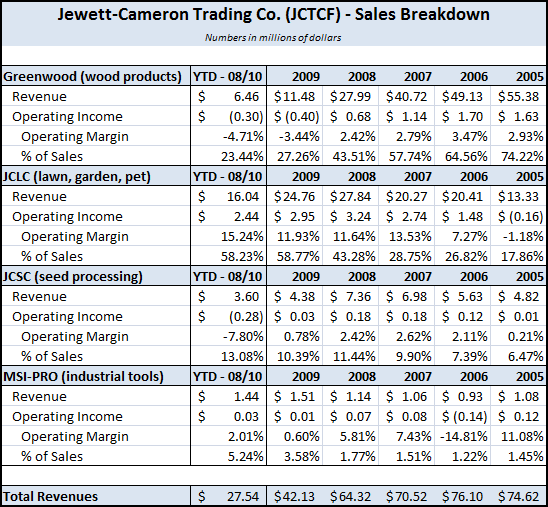
JCTCF - Operating Segment Revenue Breakdown

2009 was an extremely difficult year for JCTCF, as sales dropped 35% to $42.1M. This reduction in revenue led to a sharp decrease in net income – $0.66/shr compared to $1.09/shr in 2008.

Although sales were down basically across the board, the largest drops occurred in the wood products (-59%), and seed processing segments (-41%).

The wood products business has struggled mightily since 2005, falling almost 80% from peak sales of $55.38M. Boat manufacturers have been hit really hard by the recession, as dealers work through inventory backlog and consumers delay purchases.

Management does not believe that the boat manufacturing business will return in the near future:

“We continue to develop a readiness to participate when the market rebounds. In the meantime, we have been searching for alternative uses for our industrial wood products and developing new customer relationship”

Looking at the operating segments, JCTCF operates in a tough business environment with low single digit margins in 3 out of 4 business segments (similar to a current holding, APNC.OB, with its insurance marketing division).

The product mix has shifted towards the higher margin JCLC business, which now makes up almost 60% of sales. The company is transforming (maybe involuntarily?) into a business that relies on the lawn, garden & pet segment to drive profits.

Despite the revenue declines, the overall business remained solidly profitable in all four quarters in 2009, a trend that has continued into the first three quarters of 2010.

Company Financials

JCTCF has aggressively paid down debt, reducing its debt to equity ratio from 137.2% in 2003 to 9.6% last year – the company has no long-term debt outstanding, but has an unused $5M credit line available.

Overall, gross margins have improved as the company makes the transition into the higher margin lawn & garden business – TTM gross margin of 22.3% is the highest on record.

The balance sheet is extremely strong with a current ratio and quick ratio of 4.9 and 3.2 respectively. The company is sitting on a huge cash pile ($8.4M) or $2.71 per share in net cash after subtracting out liabilities.

CROIC & ROE have plateaued in the past five years at 10.3% and 15.3% respectively.

Risks

Management Team

The company’s CEO, Donald Boone, and Corporate Secretary, Michael Nasser, collectively control over 35% of outstanding shares.

Both executives have been with the company since 1987 and have seemed content to sit back and watch the cash position grow without any urgent concern for minority shareholders (although a recent stock buyback could be a step in the right direction).

Decline in Revenues

Sales have declined every year since 2006, and are currently almost half of the high water mark. The company’s language in the quarterly report continues to have a negative outlook on the boating sector, which used to be the major source of revenue.

If management cannot effectively guide the company into growing business segments, JCTCF’s long-term prospects could be suspect.

Positives

Share Repurchase Program

After announcing in July 2009 that the company began exploring options to increase shareholder value, management finally announced a stock repurchase program in May of this year for up to 425,000 shares, or 17.8% of the total shares outstanding.

Unusually, the company designated specified in the press release that it would only buy shares for up to a maximum of $7.00.

As of July 6, 2010, the company had purchased almost 80k shares with a month left to go in the original program. Assuming the company maintains this pace, the company would retire approx 7% of shares, making the company appear even cheaper.

Hidden Undervalued Assets

Property, plant and equipment is currently being carried at approx $1.9M, net of depreciation. However, the company owns several pieces of extremely valuable property:

“The Company’s executive offices are located at 32775 NW Hillcrest Street, North Plains, OR 97133. The 5.6 acre facility, which is owned, consists of 40,000 square feet of covered space (6,000 office, 10,000 manufacturing, and 24,000 warehouse), a little over three acres of paved yard space, and was completed in October 1995”

The property associated with JCSC, which is owned, consists of a little over 13 acres of land, 105,000 square feet of buildings, rolling stock, and equipment. It is currently used for seed processing and storage. It is located at 31345 NW Beach Road, Hillsboro, OR 97124, which is adjacent to North Plains, OR”

In all, the company owns almost 150,000 square feet of building space and almost 19 acres of in a prime location in Oregon right near a small airport and a major highway.

A quick search in Loopnet shows comparable buildings selling for approx. $17-$20/sq. ft. Undeveloped land is going for approx. $200k-$300k per acre.

At those prices, the land alone is worth over $3m and yet is sitting on the balance sheet at $635k.

Rebound in Boat Manufacturing

Although the company’s reports have been very negative on the status of boating manufacturers, other industry statistics show a glimmer of hope on the horizon.

As of July 2010, boat sales remain down 15% YoY but have been rising steadily since April 09.

As sales rebound, dealers will continue to work through their inventory backlog – an increase in manufacturing will follow, leading to increased sales for JCTCF.

While the Greenwood Products division will probably not see 2005 levels for quite some time, a resumption in sales growth and return to profitability in this segment will certainly help the stock.

Valuation
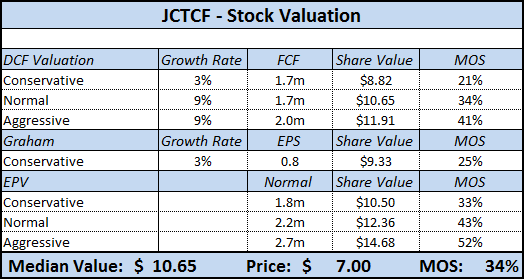
JCTCF - Stock Valuation Analysis

Using an estimated 2010 EPS of $0.80, JCTCF’s P/E ratio is 8.75, slightly below its long-term average.

After adjusting the P/E ratio to include the net cash balance ($2.71/shr), the modified P/E ratio is only 5.3.

JTCF is also selling at discount to book value as well as NCAV.

Conclusion

Over the past few years, the JCTCF managed to stay profitable, on both an earnings and cash flow basis, during an extremely difficult period and despite revenues cratering in the main business segment.

The stock is trading at a discount to its intrinsic value, and management now has the responsibility of guiding the business back to growth.

Although the share buyback is a nice gesture, management could do more – a special dividend or possible sale of one of the underperforming business segments would be a nice catalyst for future price appreciation.

Disclosure

No positions in my personal portfolio at the time of this writing.

Alpha Pro Tech LTD (APT) is a Canadian micro-cap company offering products in three different operating segments: Protective Apparel, Building Supply, and Infection Control.

The stock is down almost 70% from a high of over $7 back in October 2009. APT saw significant increase in sales due to the outbreak and threat of the H1N1 flu virus, as it increased demand substantially for the company’s protective gear.

In 2010, comparable numbers are off significantly as the H1N1 threat has abated – the market has punished the stock despite a solid balance sheet and continuing profitability.

This is a great example of the market overreacting, providing an opportunity for savvy investors to pick up shares on the cheap.

Segment Breakdown

Alpha Pro Tech (APT) - Sales Breakdown

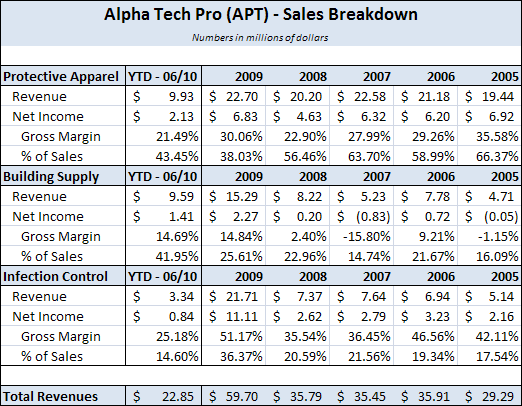
The company sells a variety of disposable protective items including shoecovers, caps, gowns, masks and eye shields, along with house wrap and synthetic roof underlayerments on the building materials side.

2009 was an incredible year for the company, with sales increasing 66.8% compared to 2008, driven by strong results in the Infection Control group. Infection Control sales almost tripled, as customers stocked up on protective gear to combat the H1N1 flu strain.

Despite the sharp drop in protective gear sales from the 2009 high-water mark, the company has managed to hold revenue numbers fairly steady in 2010, primarily due to growth in the Building Supply segment.

Building Supplies now make up over 41% of total revenues, almost double the segment average over the past five years.

Financial Information

Revenue has grown at 12.7% per year over the past five years on a solid gross margin of 46.4%. Both operating and net margins have remained stable as well, at 12.1% and 7.6% respectively.

Margins will fall as the company increases its focus on the lower margin Building Supply business, but the growth prospects should help to make up the difference.

5-yr CROIC (11.9%) and ROE (12.3%) are respectable although not outstanding.

On the balance sheet side, book value has increased at a steady rate of 16.6% per year and currently sits at $1.56/shr.

Last quarter, APT made significant inventory purchases across all product lines in order to strengthen marketplace position and ready for future sales. The company expects to generate and stockpile cash in the second half of the year as it works through inventory.

Loss of Key Distributor

In 2009, 28.7% of company sales were to VWR International, the company’s largest distributor. However, on March 29 2010, VWR decided to stop carrying Alpha Pro Tech’s product line and launch its own competitive line of products.

Although the company has slowly been transitioning away from VWR (the distributor made up 45.7% of sales in 2007), this will still have an adverse effect on financial performance as the company moves to a broader distributor network.

So far in 2010, Protective Apparel sales are off 26% – although the other business segments have picked up the slack, it remains to be seen whether the company will be able to stabilize sales through a broader distribution network.

Catalysts

Share Buybacks

In April 2009, the company announced a $2m stock repurchase program. The plan was expanded to another $2m in February 2010. While repurchases have slowed in 2010, the company has managed to retire over 6.1M in shares for an average price of $1.24 since the program was originally announced.

I’d imagine the company will begin repurchasing shares again once sales stabilize and the cash balance improves.

Business Supply Growth

Despite the troubles in housing and construction markets, APT’s Business Supply segment continues to churn out impressive results. The company has managed to operate the segment profitably, growing both top and bottom line results, and has hired additional sales staff to handle expected growth.

The company has also announced a new product offering in the third quarter which should increase market share as well.

Flu Season

In the U.S., flu season is usually marked by the October through May time period. While it is very difficult to predict the severity of the 2010-2011 season, there certainly remains the potential for another significant outbreak.

If so, APT’s products are well positioned to capitalize and provide protection where required.

The buildup in inventory will ensure the company can meet demand without costly production issues if an outbreak requires immediate supply.

Valuation

APT - Stock Valuation

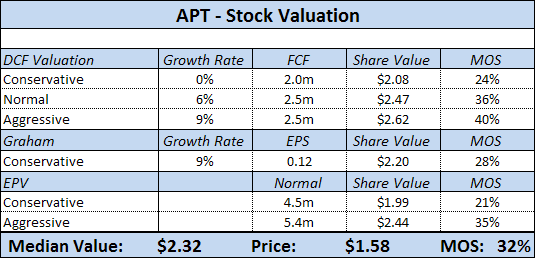
Assuming the company can deliver 2010 EPS of $0.12, the stock is currently trading at a forward P/E level of approx 13, compared to the stock’s long-term P/E average of 19.23.

Assigning the average multiple and the per-share value would be $2.31, right around my estimate.

The stock is currently trading at book value, despite a historical book value multiple closer to 2.5.

NCAV of $1.30 provides a measure of protection on the downside.

Conclusion

With Alpha Pro Tech, the market seems to be keying on the comparable YoY numbers between 2009 and 2010 rather than focusing on a business that has maintained profitability through the ups and downs in its business cycle.

The company’s Building Supply segments has shown exciting growth prospects, and while the loss of VWR’s business is detrimental to sales in the short-term, it might even offer an opportunity for APT to increase its sales network through broader distribution channels.

While $7 is too high for the stock based on current financial performance, conservative estimates peg APT’s value at north of $2.

I’m adding APT to Value Uncovered’s Model Portfolio at $1.58.

Disclosure

No positions in my personal portfolio at the time of this writing.